山东农业大学李大鹏教授团队在《Food Hydrocolloids》发表最新研究成果:超声辅助提取盐碱地大豆蛋白的热诱导凝胶特性及其形成机制
山东农业大学李大鹏教授团队在《Food Hydrocolloids》发表最新研究成果:超声辅助提取盐碱地大豆蛋白的热诱导凝胶特性及其形成机制
近日,山东农业大学食品科学与工程学院李大鹏教授、杨靖副教授团队在国际食品领域期刊《Food Hydrocolloids》(中科院一区,IF=13.8)发表题为“Heat-induced gelation of ultrasonically extracted saline-alkali-grown soybean protein: Correlation between protein conformation and gel functional behavior”的研究论文。山东农业大学为论文的第一完成单位,2024级硕士研究生韩欣慧为论文第一作者,杨靖副教授、李大鹏教授为通讯作者。研究获得山东省重点研发计划项目(2024SFGC0401)资助。
随着全球人口增长以及食品工业对健康、营养和可持续蛋白资源需求的不断增加,植物蛋白因其丰富的营养价值和良好的加工适应性受到广泛关注。大豆蛋白作为重要的植物蛋白来源,在植物基凝胶制品领域具有广阔的应用前景。凝胶特性是评价大豆蛋白加工品质的重要指标,其形成过程与蛋白质的组成、分子构象及分子间相互作用密切相关。盐碱地是我国重要的后备耕地资源,盐碱环境可能影响大豆蛋白的组成及结构,进而改变其功能特性。然而,目前关于盐碱地大豆蛋白结构特征与热诱导凝胶性能的研究仍相对有限。
本研究选取耐盐碱品种齐黄34、盐碱地种植的冀豆23和临豆21,以及普通土壤种植的嘉豆33,对传统提取与超声辅助提取所得蛋白的结构和热诱导凝胶性能进行比较。响应面法优化得到超声功率420 W、处理时间20 min、碱提pH 9.36的工艺条件。超声辅助提取使齐黄34蛋白回收率由56.00%提高至70.33%,蛋白含量由89.56%提升至91.61%,同时改善了溶解性和持水能力。盐碱地大豆蛋白总体表现出较好的凝胶性能,其中齐黄34尤为突出。首先,较高的11S/7S比例以及增加的二硫键含量为热诱导的蛋白质聚集和交联提供了有利基础。其次,超声处理诱导了蛋白质链的构象重排,促进了巯基和芳香族侧链的暴露,从而在加热条件下有利于二硫键交联、疏水相互作用和氢键的形成。此外,这些分子相互作用的增强促进了更致密且均匀的三维凝胶网络结构的形成。因此,所得凝胶表现出高硬度、强持水能力、强弹性行为以及优异的贮藏稳定性。这些发现为盐碱地种植的大豆蛋白开发植物基凝胶产品提供了基础,从而支持了盐碱地的可持续发展和高效利用。
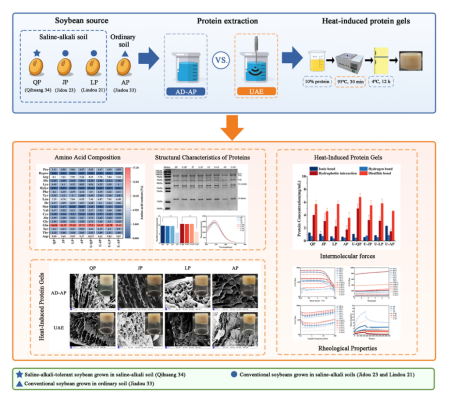
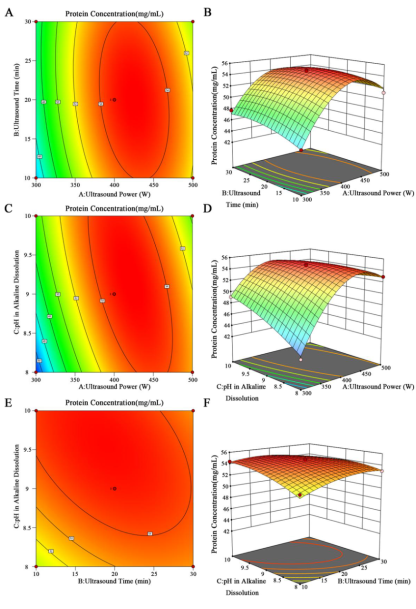
Figure 1 Interaction effects among different experimental variables on the ultrasound-assisted extraction yield of soybean protein.
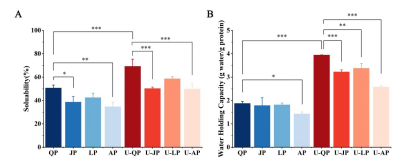
Figure 2 Effects of different extraction methods on the solubility and water-holding capacity of soybean proteins from different varieties. (A) Solubility of soybean proteins; (B) Water-holding capacity of soybean proteins.
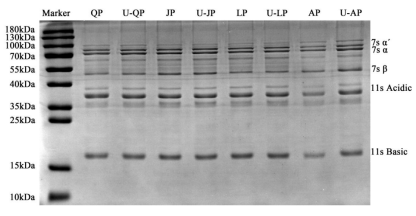
Figure 3 SDS-PAGE spectrum of different varieties soy proteins under different treatment methods.
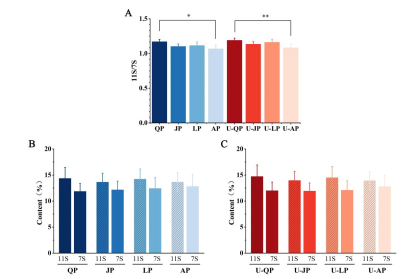
Figure 4 11S/7S ratio and 7S and 11S contents of different varieties soy proteins under different treatment methods. (A) 11S/7S ratio; (B) Contents of 7S and 11S in samples prepared using the AD-AP extraction method; (C) Contents of 7S and 11S in samples prepared using the UAE method.
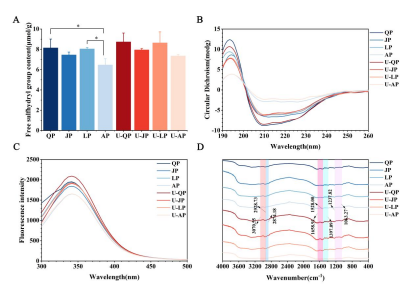
Figure 5 Structural changes of different varieties soy proteins under different treatment methods. (A)Disulfide bond content; (B)Circular dichroism spectra analysis; (C)Fluorescence spectrum analysis; (D)Fourier transform infrared spectrum analysis.
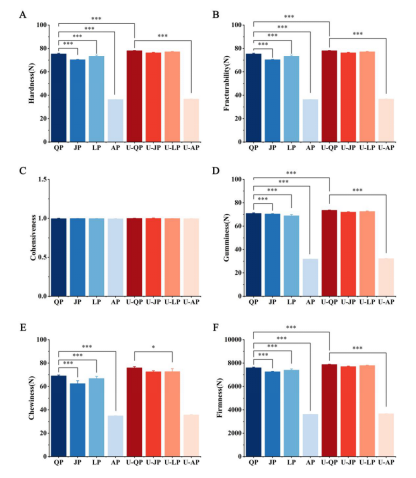
Figure 6 Perform texture profile analysis (TPA) on the heat-induced gels of different varieties soy proteins under different treatment methods.
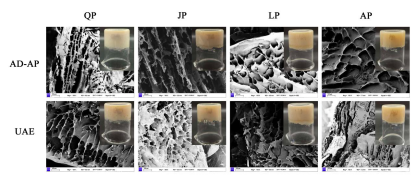
Figure 7 Effect of different treatment methods on the appearance and microstructure of heat-induced gels prepared from soybean protein of different varieties (microstructure observed at 100× magnification).
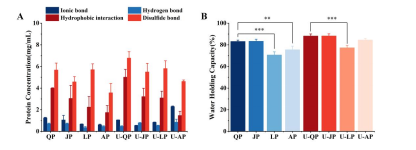
Figure 8 Intermolecular forces and Water-holding capacity of soybean protein heat-induced gels after AD-AP and UAE treatments.
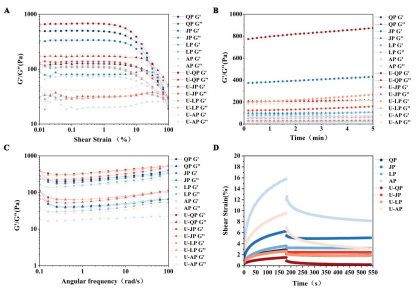
Figure 9 Rheological properties of soybean protein heat-induced gels under different treatments. (A) Strain sweep, (B) Time sweep, (C) Frequency sweep, (D) Creep-recovery tests. G′ denotes the storage modulus and G″ denotes the loss modulus.
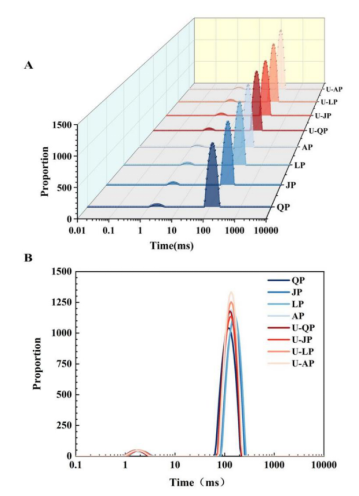
Figure 10 Low-field nuclear magnetic resonance (LF - NMR) relaxation characteristics of soybean protein heat-induced gel samples under different treatment conditions. (A) Transverse relaxation time (T2) distribution spectra; (B) T2 distribution curves.
网络
展源
何发
热点文章
-
管制范围持续扩张!美国更新“1286 ”清单,复旦、上交等上榜
2026-07-30
-

快讯!赛默飞任命Dan Rosen为中国区总裁
2026-08-18
-
2026 国自然集中接收项目评审结果放榜,多项资助规模上调
2026-08-26
-
哈工大谭久彬院士团队合作发明化学反应发光超分辨成像新方法
2026-08-14
-
安捷伦洞察检测需求,共建高效实验室市场调研
2026-09-01
-
-
北京公开征集自主实验室储备课题,覆盖多领域表征测试研究
2026-08-12

评论
加载更多