北京农学院陈湘宁、张慧娟在《Food Control》发表最新研究成果:反式-2-己烯醛抑制灰葡萄孢菌生长及调控表面真菌群落来改善樱桃采后品质
北京农学院陈湘宁、张慧娟在《Food Control》发表最新研究成果:反式-2-己烯醛抑制灰葡萄孢菌生长及调控表面真菌群落来改善樱桃采后品质
近日,北京农学院食品科学与工程学院陈湘宁教授团队在国际食品领域期刊《Food Control》(中科院一区,IF=7.0)上发表题为“Trans-2-hexenal improves cherries postharvest quality by inhibiting Botrytis cinerea growth and modulating surface fungal communities”的研究论文。北京农学院为论文第一完成单位,2024级研究生张玲玲为论文第一作者,陈湘宁教授、张慧娟讲师为通讯作者。
樱桃果实营养丰富,富含抗氧化多酚、类黄酮、有机酸及多种微量营养素,深受消费者喜爱。据USDA数据,2024年全球樱桃产量约490万吨。然而,樱桃采后极易受到真菌侵染,病原菌通过果皮或伤口侵入后,初期形成水渍状斑点,随后扩展为白色或灰绿色菌丝,伴随果实软化、组织腐烂和汁液渗出,最终导致果实萎缩、褐变、产生异味,货架期大幅缩短。目前,化学保鲜剂仍是控制樱桃采后病害的主要手段,但部分化学物质存在环境与健康风险。反式-2-己烯醛(TH)是一种天然存在于烟草、茶、萝卜叶等植物中的挥发性化合物,已被证实对禾谷镰刀菌、李斯特菌、灰葡萄孢菌等多种病原微生物具有抑制作用,并在草莓、梨、桃、芒果等果实采后保鲜中展现出应用潜力,但其在樱桃保鲜中的效果和机制尚缺乏系统研究。
本研究以大连美早樱桃为材料,首先从贮藏果实表面分离鉴定出灰葡萄孢菌为优势致病真菌,并确定TH对其最小抑菌浓度(MIC)为0.4 mg/L,并结合扫描电镜、胞外电导率、pH、蛋白质和可溶性糖泄漏、丙二醛含量及ITS扩增子测序,系统解析反式-2-己烯醛的抑菌机制。随后在自然贮藏和人工刺伤接种条件下,系统评价0.2、0.4、1.2 mg/L TH的保鲜效果。结果表明,1.2 mg/L TH处理效果最佳:自然贮藏12天腐烂率由51%降至6.7%,并显著延缓失重、硬度下降、色泽劣变以及可溶性固形物、可滴定酸和抗坏血酸含量降低,同时减少丙二醛(MDA)积累。机制上,TH通过破坏灰葡萄孢菌细胞膜完整性,引起电解质、蛋白质和可溶性糖泄漏,并加剧膜脂过氧化,从而抑制菌丝生长;同时重塑樱桃表面真菌群落,使Botrytis相对丰度由41.58%降至0.62%,促进有益菌Vishniacozyma和Rhodotorula增殖,提高Chao1、Shannon和Simpson指数,维持群落多样性和稳定性。该研究证实,TH可通过“直接抑菌+群落调控”双重机制改善樱桃采后品质,为樱桃绿色保鲜提供了新策略。
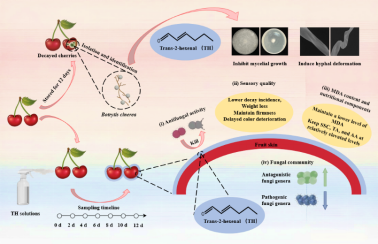
Graphical abstract
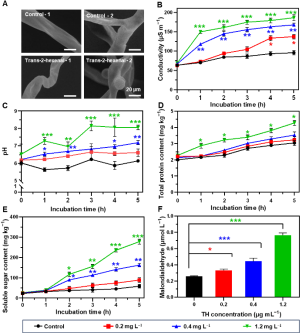
Fig. 1 Inhibitory effect of trans-2-hexenal on Botrytis cinerea in vitro. Mycelial microstructure was interrupted by trans-2-hexenal (A), conductivity of B. cinerea mycelia (B), extracellular pH (C), protein leakage (D), soluble sugar content (E) of B. cinerea mycelia. malondialdehyde content of B. cinerea (F).
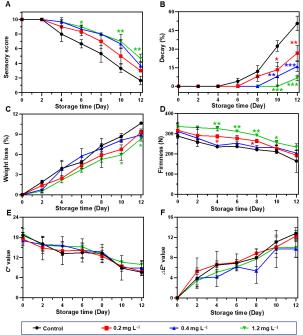
Fig. 2 Effects of trans-2-hexenal on quality parameters and physicochemical indicators of cherry fruit. Sensory scores (A), decay (B), weight loss (C), firmness (D), C* value(E), and ΔE* value (F) of cherry fruit.
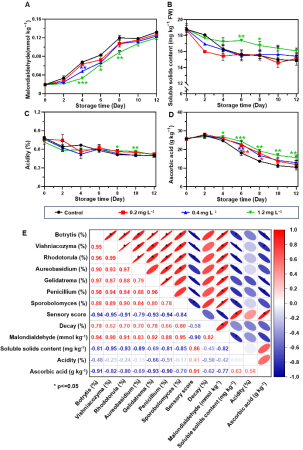
Fig. 3 Effects of trans-2-hexenal on malondialdehyde content and nutritional indicators of cherry fruit. Malondialdehyde content (A), soluble solids content (B), acidity (C), ascorbic acid (D) content and the Pearson correlation analysis of fruit quality parameters and fungal genus abundance (E).
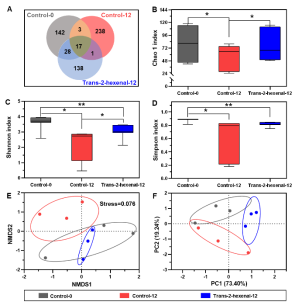
Fig. 4 Analysis of microbial diversity of cherry surfaces fungal communities under trans-2-hexenal treatment and control during storage. Venn diagram (A), Chao 1 index (B), Shannon index (C), Simpson index (D), Non-metric multidimensional scaling analysis (E) and Principal component analysis (F) of fungal communities under different treatments.
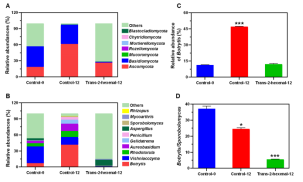
Fig. 5 Dynamics of fungal community composition on cherry surfaces under different treatments. Dynamics of relative abundance of fungal phyla on cherry surfaces under different treatments (A). Dynamics of relative abundance of fungal genera on cherry surfaces under different treatments (B). Relative abundance of Botrytis at the genus level (C). Ratio of Botrytis to Sporobolomyces at the genus level (D).
原文链接
https://doi.org/10.1016/j.foodcont.2026.112650
网络
展源
何发
热点文章
-
管制范围持续扩张!美国更新“1286 ”清单,复旦、上交等上榜
2026-07-30
-

快讯!赛默飞任命Dan Rosen为中国区总裁
2026-08-18
-

2026 国自然集中接收项目评审结果放榜,多项资助规模上调
2026-08-26
-
哈工大谭久彬院士团队合作发明化学反应发光超分辨成像新方法
2026-08-14
-

安捷伦洞察检测需求,共建高效实验室市场调研
2026-09-01
-

-

北京公开征集自主实验室储备课题,覆盖多领域表征测试研究
2026-08-12


评论
加载更多